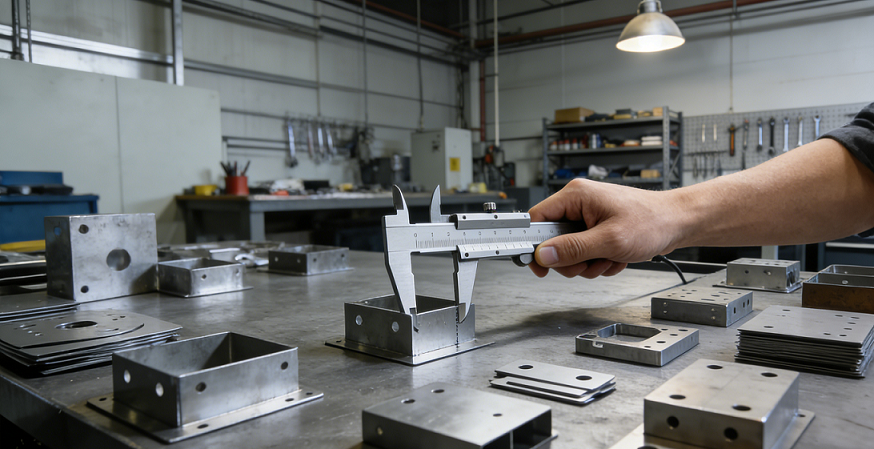
Non-standard electrical control cabinet shell sheet metal processing guide
A Complete Guide to Non-Standard Electrical Control Cabinet Housing Sheet Metal Processing: Processes, Standards, and Customization Essentials Explained
In industrial automated production lines, smart factories, and power distribution systems, PLC cabinets, frequency converter cabinets, and electrical control cabinets are the "nerve center" ensuring stable equipment operation.
The processing precision, structural rigidity, and protection level of the cabinet housing directly determine the safety of internal components and the system's lifespan.
Standard cabinet types often struggle to adapt to complex operating conditions, special dimensions, and customized functional requirements, making non-standard electrical control cabinet housing sheet metal customization an industry necessity. As a source manufacturer in Foshan, Guangdong, specializing in control cabinet housing processing, we have been deeply involved in non-standard sheet metal processing for many years. Today, we will explain the core essentials from material selection and processes to quality standards, helping you avoid customization pitfalls.
I. Core Positioning: Adapting to Industrial-Grade Scenarios, Balancing Precision and Mass Production
We specialize in non-standard electrical control cabinet housing customization, primarily covering industrial-grade PLC cabinets, frequency converter cabinets, and electrical control cabinet housings.
The core processing revolves around four key indicators:
Dimensional accuracy: Strict control over shape, hole positions, and gap tolerances
Structural rigidity: Deformation-resistant, high load-bearing capacity, suitable for heavy-duty components
Sealing and dustproofing: Meets IP54/IP55 protection standards
Surface texture: Uniform coating, corrosion-resistant and durable, conforming to GB/T 30439.1 national standard, balancing mass production efficiency and cost control, and can be directly used as a basis for workshop SOPs and external acceptance. II. Material Selection Standards: Ensuring Cabinet Quality from the Source
70% of the cabinet's lifespan depends on the material selection. We strictly select materials according to component grading, refusing to use inferior materials:
1. Main Frame: Prioritize electro-galvanized steel sheets, offering excellent corrosion resistance, requiring no pickling, environmentally friendly, and suitable for mass production.
2. Door Panels/Mounting Plates: Use high-quality cold-rolled steel sheets, ensuring high flatness, easy forming, and good welding performance.
3. Thickness Grading
Frame/Door Panels: ≥2.0mm, ensuring load-bearing capacity and deformation resistance.
Side Panels/Top Panels/Bottom Panels: 1.2~1.5mm, balancing lightweight and strength.
Mounting Plates: ≥2.5mm, supporting heavy components such as PLCs and frequency converters.
III. 10 Core Processes: Full-Process Control from Material to Finished Product
The processing of industrial control cabinet shells is far more than simple "cutting, bending, and welding." Each process has stringent requirements to ensure the finished product meets standards:
1. Raw Material Acceptance
Check material, thickness, and surface quality. SECC 1. Screen Covering: The sheet metal must be free of exposed zinc and scratches; SPCC sheets must be free of rust and oil stains; thickness tolerance ≤ ±0.05mm, avoiding bending springback and abnormal welding gaps.
2. CNC Laser Cutting: A 3000W or higher fiber laser cutting machine is used to process the outer contour, mounting holes, cable entry holes, and louvered ventilation holes (higher inside, lower outside); a 5×5mm or R3 process notch is reserved at bends to prevent tearing; hole positions are based on the left/bottom of the cabinet to ensure batch consistency.
3. Deburring/Chamfering: All cut and bent edges are deburred, and sharp edges are chamfered to 0.5×45°; special attention is paid to the edges of door panels, cable entry holes, and mounting plates to prevent scratches and damage to sealing strips.
4. CNC Bending (Key to Forming)
Ordinary Components: Bending radius ≥ 0.5t, angle 90°±0.1°, door panels with herringbone/cross-shaped ribs (rib height 6~8mm) to prevent deformation.
5. Riveting/Tapping
Prioritize riveting to avoid stripping threads on thin plates; rivet S-M4/M5/M6 nuts on hinges and door locks; after riveting, nuts should be flush and not loose; tap only on thick plates (≥3mm), ensuring clear threads without broken teeth, and remove metal filings.
6. Frame Assembly/Box Welding
Box Welding: Base and frame fully welded, welds uniform and without incomplete welds; heighten the base by fully welding the four corners to ensure the top surface is level.
7. Post-Welding Shaping/Grinding
Grind welds to be flush with the base material, without weld beads or dents; use tooling to correct the cabinet's squareness, ensuring smooth and uninterrupted door opening and closing.
8. Electrostatic Powder Coating
Color Matching: Cabinet body RAL series light gray, base RAL series black, two-tone coating
Process: Electrostatic powder coating, groove touch-up spraying, curing at 180~200℃ for 20~25 minutes
Quality: Uniform coating without runs, pinholes, or color difference; film thickness 60~80μm
9. Pre-installed Accessories (Functional Core)
Sealing: Slotted PU foam sealing strip, compression rate 30%~40%, non-detachable
Grounding: Door frame equipped with copper braided grounding terminal, resistant to PLC signal interference
Accessories: Mounting square hole strip, heavy-duty hinges (load capacity ≥60kg), three-point linkage lock, lifting ring, rubber protective coil
IV. Precision and Protection: Quantitative standards, rejecting vague acceptance
Dimensional Accuracy: Cabinet body external tolerance ±1mm, diagonal error ≤1mm, door panel gap uniformity ≤1mm, mounting hole position accuracy ≤±0.1mm
Protection Quality: Door panel and cable inlet sealing meets standards IP54/IP55, surface coating adhesion ≥1 level (cross-cut adhesion test), durable and non-peeling indoor epoxy polyester powder coating.
V. Advantages of Being a Source Manufacturer: One-stop customization, guaranteed delivery and on-time performance.
As a source manufacturer with independent processing capabilities, we provide a one-stop solution from materials to molding:
Supports customization based on drawings and samples, adapting to various non-standard needs.
Abundant and diverse processing materials, rapid order response.
Own spraying and processing plant, strict quality inspection throughout the process, controlling precision and structure.
Guaranteed delivery time and quality, suitable for industrial bulk purchases and urgent project orders.
Conclusion: Industrial control cabinet housings are the "protective armor" of industrial control equipment. The core of non-standard customization lies in process standardization, controllable precision, and compliance with protection standards.
If you have needs for non-standard electrical control cabinet housings or customized welded cabinet processing, please feel free to contact us. With professional technology and source production capacity, we provide reliable cabinet support for your automation projects!
Custom Sheet Metal Deformation Causes