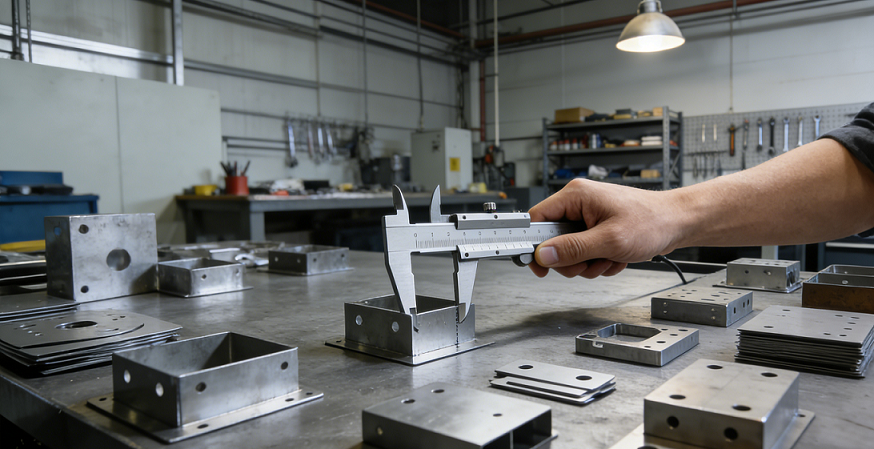
bending stress
Sheet metal bending and embossing guide
I. Sheet Metal Bending: Function and Challenges Coexist
In sheet metal fabrication, bending serves as a fundamental shaping technique. It enables the production of accurate geometries, thereby improving both the mechanical performance and aesthetic appeal of customized components and enclosures. More importantly, proper bending reduces welding and assembly processes, minimizing material waste and making sheet metal parts more versatile in industries such as electronics, machinery, and automotive.
However, two core issues consistently plague engineers during bending:
Material cracking: When stress concentration at the bending point exceeds the material's tolerance limit, cracks will directly occur;
Edge vulnerability: Material edges exhibit susceptibility to tearing or deformation, leading to geometric irregularities in component profiles. This phenomenon undermines both mechanical performance and aesthetic quality.
II. What is Bending Embossing? A Key Design Solution to Pain Points
To overcome these challenges, bending embossing (also known as embossed cutting) is the most effective solution.
It involves creating small, intentional cuts at the end of the sheet metal bend, suitable for almost all customized sheet metal designs—especially when the bend is near edges, tabs, or corners (where material is highly susceptible to damage from overstretching).
By cutting through areas of stress concentration, bending relief allows sheet metal to bend smoothly while maintaining dimensional accuracy, preventing tearing, cracking, or warping at its source.
III. The 4 Core Values of Bending Relief
Why is bending relief considered the "invisible guardian" of sheet metal design? Its value mainly reflects four aspects:
Crack and Tear Prevention: It creates "stress breakpoints" in the material, preventing excessive stretching during bending, especially suitable for tightly bent parts with narrow flanges or small bending radii;
Warping Suppression: It ensures material deformation follows an optimal path, eliminating edge distortion and upholding shape precision;
Detail Protection: The method decouples bending stress from nearby features (holes, grooves, etc.) to preserve critical structures' dimensional precision;
Aesthetic Improvement: Refines part corners for a cleaner appearance, minimizing visual distortion—especially enhancing exposed flange shells or components.
IV. Scientific Design: A Practical Guide to Bending Reliefs
Designers must follow 'process-material adaptation' principles to achieve superior bending relief performance. Specific standards are as follows:
Basic Design Principles
Width: The width of the anti-cracking groove should be equal to or slightly larger than the material thickness.
Depth: It should slightly exceed the bending radius to avoid residual stress.
Shape: You can select rectangular, rounded, or custom styles according to the needs of the part.
Detailed Standards Based on Processing Technology
Laser-cut Parts
Width: Must meet the industry's basic processing accuracy and extend inwards by the corresponding distance from the bending radius.
Shape: Flexibly select rectangular or circular shapes.
Milling-cut Parts (Suitable for bent aluminum parts with cavities and countersunk holes)
Width: Increases synchronously with the material thickness.
Shape: We prefer circular reliefs to adapt to the characteristics of milling processing.
General Rules of Thumb
The minimum relief width should be ≥50% of material thickness or the conventional processing threshold, whichever is higher. For thinner materials, site-specific adjustments are permissible after feasibility validation.
V. Conclusion: Key Details Not to Be Overlooked
This 'small notch' in bending processes is a decisive factor for part durability and performance. Overlooking this design may result in material waste, higher production costs, and compromise the final product's performance.
Proper bending relief settings, guided by material properties and process techniques, ensure accurate sheet metal bending—balancing functionality and aesthetics.
Post-Forming Care for Instrument Sheet Metal Components
Sheet Metal Springback