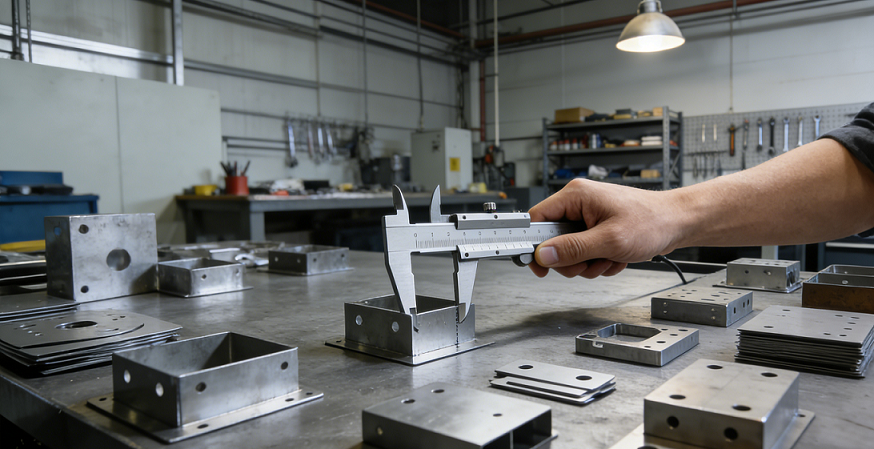
Comparing Sheet Metal and CNC Methods
Comparing Sheet Metal and CNC Methods
Looking for a piece of metal to transform into a housing or a structural component? First, distinguish between the two paths: sheet metal fabrication and CNC machining. The former is like origami, the latter like carving; the processes, costs, and results are completely different.
1. Raw Material Form
Sheet metal fabrication begins with flat metal sheets or coils of consistent thickness.
CNC machining, on the other hand, starts with the "block," and can include bars, forgings, solid plates, and any thickness. It can also cut metal or plastic.
2. Core Actions
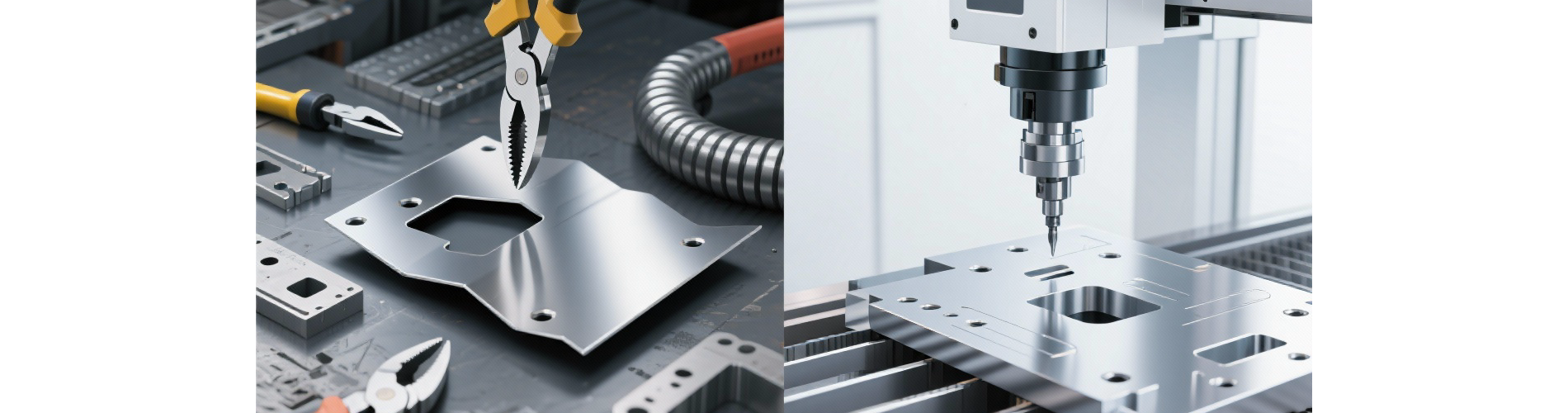
Sheet metal relies on "deformation": shearing, punching, bending, and riveting to create edges, holes, and ribs on flat sheets with minimal material loss.
CNC machining relies on "removal": milling cutters and drills rotate around the blank, shaving off excess metal layer by layer until the desired shape is left.
3. Equipment and Process
In the sheet metal workshop, CNC punches punch ten holes per second, and press brakes form corners. Followed by spot welding, wire drawing, and powder coating, the process is fast and suitable for large-scale production.
In the CNC workshop, high-speed spindles rev at 20,000 rpm. While seemingly bustling, the tool paths are delicate, processing time is long, and changeovers are slow, making it more suitable for small and medium-sized batches.
4. Geometric Freedom
Sheet metal excels at straight lines, hemming, flanging, and shallow drawing, with mobile phone cases, case doors, and electrical cabinets being its signature products. However, it struggles with deep cavities, curved surfaces, and threads.
CNC machines, on the other hand, can carve complex curved surfaces, internal cavities, and inclined holes in solid blocks. They are used in drone frames, engine impellers, and mold cavities.
5. Dimensional Accuracy
Sheet metal hole placement of ±0.1 mm is considered excellent. Bending angles are affected by material springback and require subsequent adjustment.
CNC machines easily achieve ±0.01 mm, and critical mating surfaces can be ground to the micrometer level, allowing for immediate installation of sealing rings.
6. Cost Curve
Sheet metal molds are inexpensive; punching dies cost a few hundred yuan, and bending knives are universal. Material waste per piece is minimal, and the larger the production volume, the cheaper it is.
CNC tools are expensive, with titanium alloy shanks costing over a thousand yuan each. Cutting time is long, and material utilization is around 30%. The reduction in time per piece is limited with larger production volumes. If you're only making one or two pieces, CNC is actually more economical because it eliminates the need for molds.
7. Surface and Post-Processing
After forming, sheet metal parts are first deburred, then powder coated and electroplated for a uniform color. Seams require polishing.
CNC parts have fine cuts and can be directly anodized, hard-oxidized, or mirror-polished. If you want to spray paint, you have to sandblast it first so that the paint can stick better.
8. Weight and Strength
Sheet metal parts have uniform wall thickness. Reinforcement in certain areas can only be achieved by welding nuts or rivet brackets, resulting in a relatively light overall weight.
CNC parts can be constructed as solid frames with thinned ribs in certain areas, leaving thick reinforcement in load-bearing areas. This results in a better strength-to-weight ratio, but the finished product is heavier.
9. Delivery Time and Flexibility
By aligning your needs with the process, budget and delivery time will naturally fall into place, eliminating the need for agonizing metalworking.
CNC design changes require reprogramming toolpaths, clamping, and debugging for at least two hours, making urgent orders challenging.
10. Summary
If you need a housing, speed, and cost-effectiveness, choose sheet metal.
If you need structure, precision, and complexity, choose CNC.
Simply align your requirements with your process flow to automatically balance budgets and deadlines, exclude the hassles of metalworking.
Aluminum: The Ideal Choice for Sustainable Construction
The breakthrough of customized processing