Deep Drawn Stamping--Multifunctional Metal Manufacturing Driver
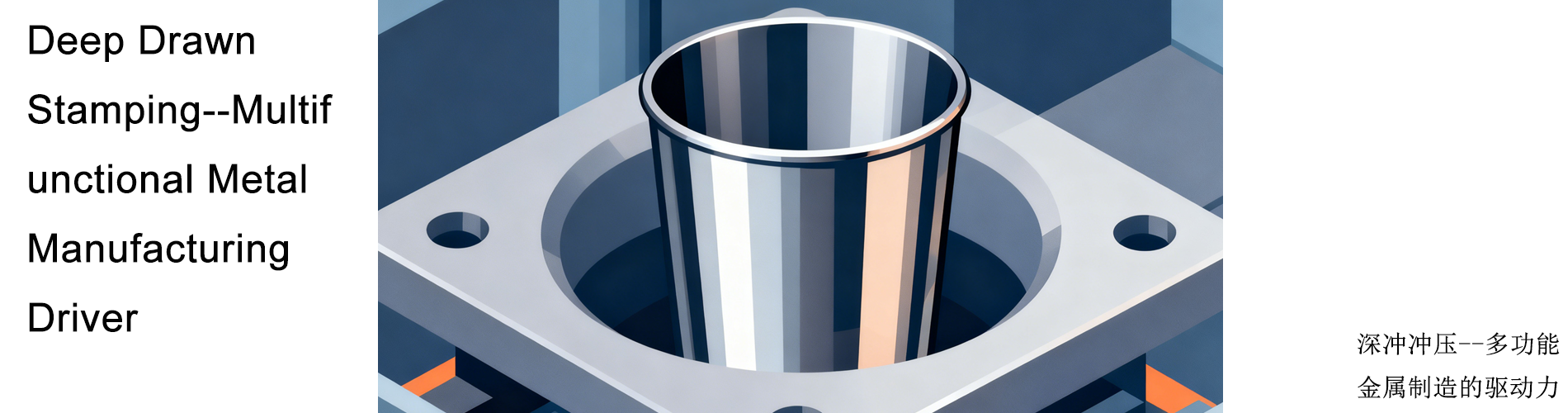
In the metal manufacturing industry, there is a process that enables both mass production and the creation of complex parts with high precision and durability—this is deep draw metal stamping.
This technology changes sheet metal using pulling or pushing forces. It is now part of our daily lives and industry. You can see it in everyday items like beverage cans and in precise parts for aerospace. Today, we'll delve into this practical and powerful manufacturing process.
I. What is Deep Drawn Metal Stamping?
Deep draw metal stamping is a core sheet metal processing technology. Its core principle is to transform flat sheet metal into specific shapes such as cavities, cylinders, and cups by applying tensile or compressive forces. Unlike traditional processing methods, it eliminates the need for multiple cuts and joins in the metal. Instead, through the cooperation of molds and punches, complex shapes can be formed in one or a few steps, allowing the sheet metal to flow naturally under stress, ultimately forming a structurally complete finished product.
II. Core Advantages of Deep Drawing Metal Stamping
As a preferred manufacturing method, deep drawing metal stamping offers notable advantages, driving its broad adoption.
Its biggest advantage is its ability to produce large amounts of products quickly. This helps meet the needs of big industrial production and greatly boosts efficiency.
This process can create complex structures directly. It does not need welding, cutting, or other assembly steps. This simplifies production and reduces assembly errors and safety risks.
The performance of the finished products is also excellent. Parts created using the deep drawing process have seamless characteristics, inherently possessing airtightness and waterproofing advantages, making them indispensable in scenarios requiring sealing performance. Additionally, the finished products feature high durability and strength, withstanding complex environments and extending their service life effectively.
III. Limitations of the Process
Of course, deep drawing metal stamping is not a panacea; it also has certain application limitations.
Due to the high radial and compressive stresses generated during the process, these stresses may lead to defects such as cracking, fracture, or wrinkling in metal parts, placing high demands on production control. Meanwhile, this process demands high levels of equipment and specialized skills, resulting in significant initial investment costs. This renders it economically impractical for small-batch production due to disproportionately high amortized costs per unit, thereby undermining overall efficiency.
IV. Deep Drawing Metal Stamping Workflow
The deep drawing metal stamping workflow is clear and concise, consisting of three core steps, each crucial to the final product quality.
The first step is fixing the metal sheet. Operators accurately place the metal sheet on the mold or blank holder, ensuring even placement to prevent subsequent forming defects due to misalignment.
The second step is the stamping process. A punch with preset force directly impacts the metal sheet. Under pressure, the metal sheet deforms along the mold's shape, gradually forming cavities, cups, or other pre-set irregular shapes.
The third step is obtaining the finished product. After multiple stamping processes to ensure the metal fully conforms to the mold, operators remove the product. At this point, the finished product has reached its complete form. You can use it directly or apply simple post-processing as needed.
V. Key Differences Between Deep Drawing and Conventional Stamping
Many people confuse deep drawing metal stamping with conventional stamping, but they differ significantly in their forming logic and finished product appearance.
Deep drawing is a method where a metal sheet is "drawn" into a specific mold. In contrast, conventional stamping shapes the metal sheet by "impacting" it with the mold.
Deep drawing metal stamping creates finished products with high precision and a smooth surface. It does not need extra processing. In contrast, conventional stamping has lower precision. It often needs extra steps like embossing and secondary forming to improve the surface finish.
In terms of cost, deep drawing relies on high-precision equipment and specialized technology, resulting in significantly higher production costs than conventional stamping; conventional stamping, on the other hand, requires no complex equipment, giving it a more pronounced cost advantage. Deep-drawn parts are stronger, but the metal sheet gets thinner during the drawing process.
This method cannot make tight bends. On the other hand, conventional stamping makes weaker products with only slight thinning. However, it can easily create tight curves.
VI. Applicable Materials and Common Configurations Deep drawing metal stamping boasts exceptional compatibility, capable of processing a wide variety of metal materials to meet the performance requirements of diverse applications.
Commonly applicable metals include brass, titanium, stainless steel, precious metals, cold-rolled steel, aluminum, and copper-based alloys. These materials, with their excellent ductility and plasticity, perfectly suit the forming requirements of deep drawing processes.
In terms of configuration selection, this process is also highly flexible, allowing for the selection of appropriate processing methods based on product design needs. Commonly used configurations include cup drawing, stepped drawing, reverse drawing, bulging, thread rolling, punching, hemming, necking, and knurling. Each configuration corresponds to a specific product form and can achieve the processing of complex structures.
VII. The products have a wide range of applications and cover all industries. The application scope of deep drawing metal stamping is far beyond imagination.
In daily life, yogurt cups, aluminum cans, faucets, sinks, kitchenware, and plastic buckets are all products of this process. In industrial production, core products such as automotive body parts, fuel tanks, and bathtubs also rely on this manufacturing process.
From an industry perspective, this technology has become a core processing technology in multiple fields:
the automotive industry uses it to produce body structural parts and fuel tanks;
the aerospace industry relies on it to manufacture precision structural parts;
the medical industry uses it to create high-precision medical device housings;
Industries like communications, construction, military, and electronics rely on its support. This makes it a key manufacturing force that helps these industries grow.
Deep drawing metal stamping, with its high efficiency, precision, and multifunctionality, occupies an irreplaceable position in the metal manufacturing field. It meets the efficiency needs of large-scale production. It also ensures high-quality and high-performance products. This makes it easy to manufacture complex metal parts.
Servo motor cover Protecting the core of the motor
metal design